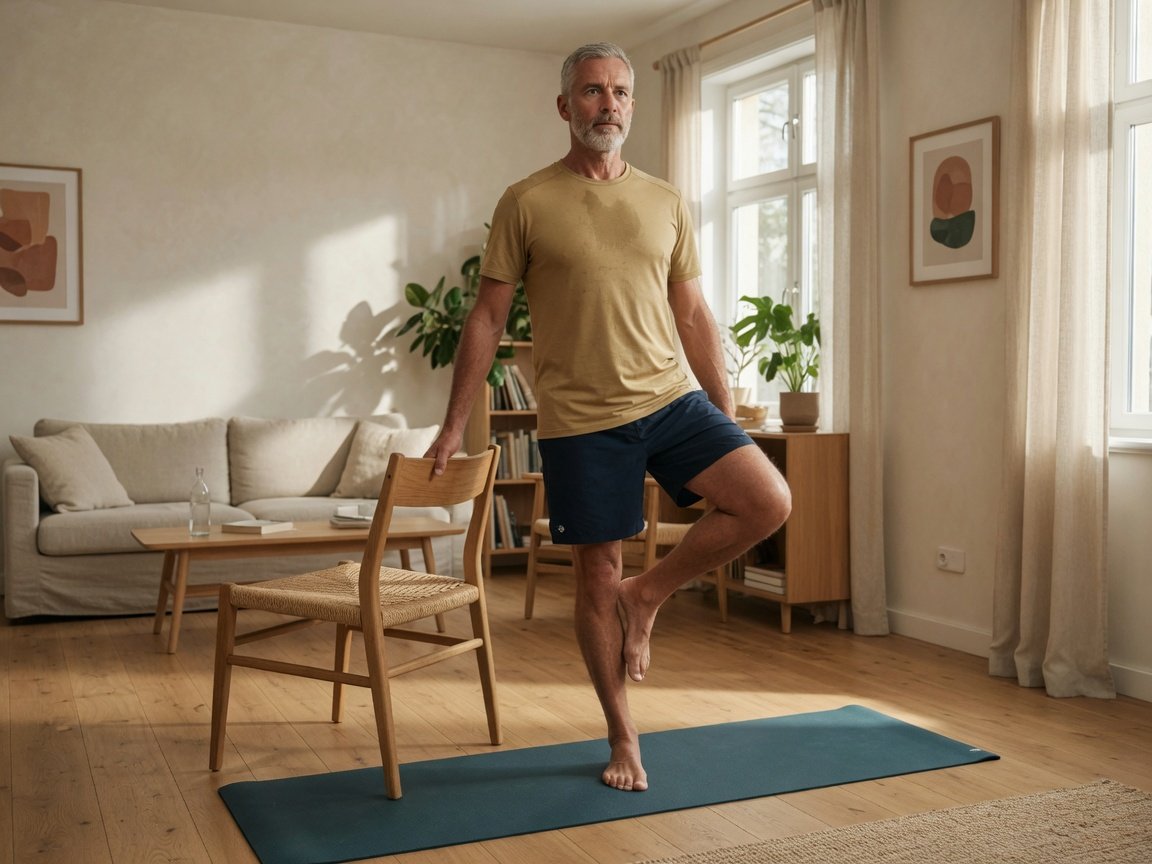
Balance exercises after 50 are short, specific stance drills you practice with a counter nearby. Three sessions a week, 8 to 12 minutes, reduce the odds of a stumble turning into a fall. They belong next to walking and strength in the fitness over 50 guide.
Why practice balance on purpose?
Balance is a skill. Ankles, hips, eyes, and attention all contribute. If you only sit and walk on flat ground, the skill gets rusty.
I am 64 and a grandfather. I practice tandem stance in the kitchen because playgrounds and curbs do not send a calendar invite. Ten minutes is enough.
What balance exercises after 50 should I do?
Hold a counter with two fingers at first. Progress to one finger, then hover the hand.
| Drill | Dose | Rest | Beginner swap |
|---|---|---|---|
| Feet together hold | 3 × 20–30 sec | 20 sec | Stand near a corner |
| Tandem stance (heel to toe) | 3 × 20 sec/side | 20 sec | Staggered stance, not full tandem |
| Sit-to-stand, slow | 2 × 6 | 45 sec | Higher chair, hands on seat |
| Weight shift side to side | 2 × 8/side | 20 sec | Smaller shift |
| Clock reach (toe tap around a clock) | 2 × 4 each direction | 30 sec | Hold the counter the whole time |
| Single-leg hold | 3 × 10–20 sec/side | 30 sec | Keep a toe on the floor |
Do this circuit three days a week. After the last drill, walk 20 steps heel to toe along the counter.
How do I progress without getting reckless?
- Week 1–2: two-finger support, all drills except single-leg. Use toe-down single-leg if you want it.
- Week 3–4: one-finger support. Add single-leg holds for 10 seconds.
- Week 5–6: hover the hand. Turn the head slowly left and right only if the stance stays quiet.
- Never practice near stairs or a wet floor. Never add a wobble board until the floor holds are easy.
- If a knee or hip nags, keep tandem and weight shifts and skip deep clock reaches. Pair with flexibility after 50 and exercises for joint pain after 50.
- Strength still matters for hips and ankles. Use the best exercises after 50 and bone health exercises after 50 so the legs can catch you.
How do I make the house safer while I train?
Practice next to a counter, not next to the stairs. Clear throw rugs from the drill space. Night lights in the hallway help more than another gadget.
Shoes with a little grip beat socks on tile. Barefoot on a yoga mat is fine if the mat is not sliding.
If you have fallen before, tell your doctor. Dizziness is not a “push through it” cue. It is a medical cue. These drills are for people who are cleared to stand and practice.
I do tandem stance while the coffee brews. That is the whole habit. Ten minutes three days a week plus that daily hold is how balance work actually happens at 64.
How do I know balance is improving?
You hover the hand more. You can turn your head a few degrees without grabbing the counter. Getting pants on while standing feels less wobbly. Those are the tests that matter, not a circus single-leg hold on a foam pad.
If you feel worse after drills, you progressed too fast or you are holding your breath. Breathe. Shorten the hold. Put two fingers back on the counter.
Balance exercises after 50 are not a replacement for strength or walking. A strong sit-to-stand gives you a bigger margin when you stumble. Do the drills and keep the lifts.
What should you read next?
Keep using this plan for four weeks before you add extras. Then branch out.
Frequently asked questions
How often should I do balance exercises after 50?
Three days a week, 8 to 12 minutes. Daily 30-second holds at the counter also help.
How long until balance improves?
Many people feel steadier in two to three weeks if they practice, not just read about it.
Should I close my eyes?
Not at first. Master open-eye holds at the counter. Eyes-closed work is advanced and needs a spotter or a corner.
What if I have fallen before?
Get medical clearance, practice next to a counter, and consider a physical therapist if dizziness is involved.
Can strength training replace balance drills?
Strength helps. Specific stance practice still matters. Do both.