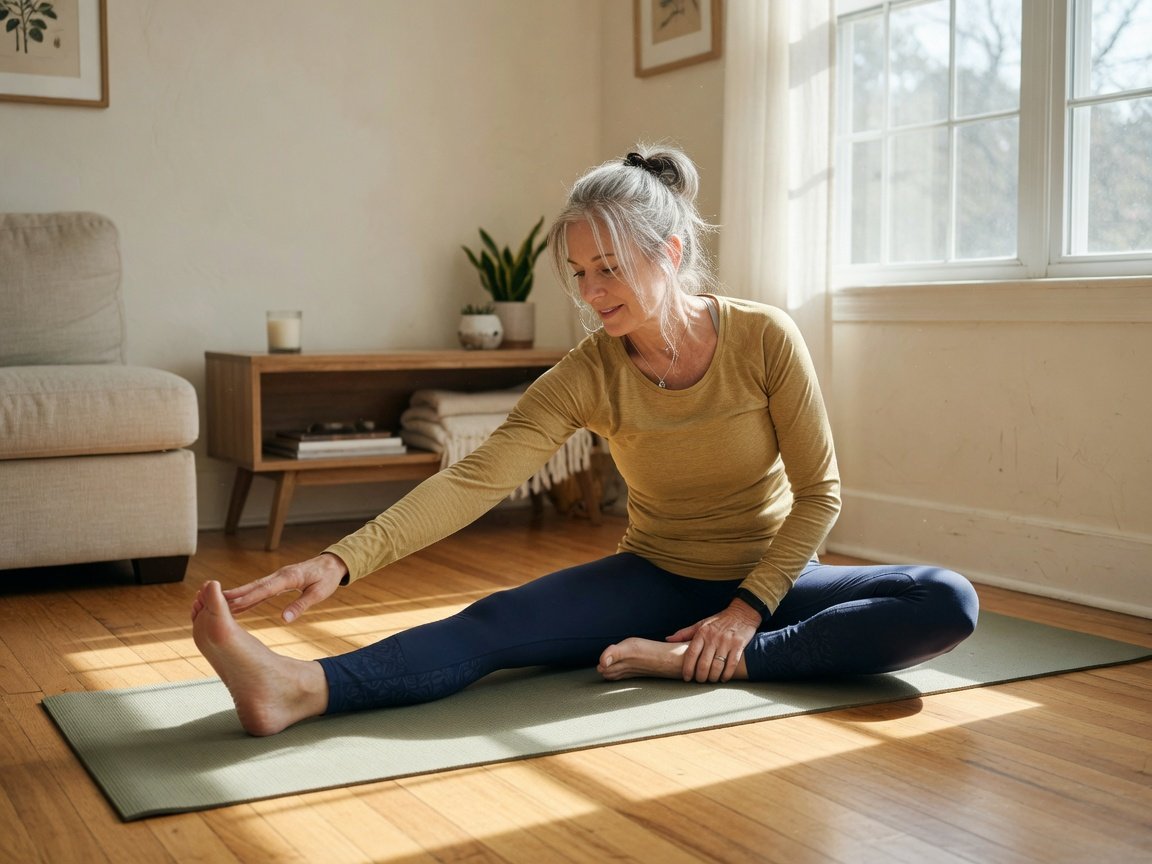
Flexibility after 50 is daily mobility you can finish in ten minutes, not splits and not a 90-minute class. Hips, calves, chest, and mid-back do most of the work for walking, lifting, and balance. Use this sequence after the fitness over 50 guide walks and lifts.
What is the 10-minute mobility sequence?
Breathe slowly. Ease into each position for 30 to 40 seconds. Two rounds if you have time, one round if you do not.
| Move | Time | Chair swap |
|---|---|---|
| Ankle rocks (knee over toes, gentle) | 30 sec/side | Hold a counter |
| Calf stretch at a wall | 30–40 sec/side | Shorter stance |
| Hip flexor stretch in a half-kneel or standing | 30–40 sec/side | Standing lunge hold at a chair |
| Figure-four glute stretch on a chair | 30–40 sec/side | Keep the foot on the floor if the hip pinches |
| Open book or seated thoracic rotation | 6 slow reps/side | Seated, hand on chest |
| Doorway chest stretch | 30 sec/side | Smaller elbow bend |
| Cat-cow on all fours or seated | 8 slow breaths | Seated, hands on thighs |
That is the whole list. If you only have four minutes, do calves, hip flexors, and chest.
When should I do it?
- After walking, while you are already warm.
- After strength, instead of collapsing into a chair.
- In the evening if you sit a lot during the day.
- Skip forcing a hamstring stretch until your back is round and angry. Use the chair figure-four instead.
- Pair with balance exercises after 50 on Wednesday. Stiff ankles make balance worse.
- If a joint pinches, stop that move and use exercises for joint pain after 50. For energy, do this sequence then a 12-minute walk from the energy after 50 page. Keep the best exercises after 50 as the main training.
What if I sit most of the day?
Do the sequence after the first walk, not after you have been still until 9 p.m. Warm tissue is easier to move. Cold, long holds on a stiff back often feel worse the next morning.
Hamstring stretching with a rounded back is a common way people irritate the low back and call it “tight hamstrings.” Use the chair figure-four and the calf wall stretch instead.
Flexibility after 50 is maintenance. It is not a personality. Ten minutes. Then go live your life. Strength and walking still do more for independence than any stretch.
What about a stiff back in the morning?
Do not fold in half the moment you get out of bed. Walk to the kitchen. Drink water. Then do seated cat-cow, the doorway chest stretch, and a gentle hip flexor hold at the counter. Five minutes. Then a short walk if you can.
Morning stiffness is common after 50. It often eases as you move. If it does not ease, or if you have numbness, see a doctor. Stretching is not a diagnosis.
People overdo spine stretching because it feels like “doing something.” The back often wants blood flow and stronger hips more than it wants a deeper fold. That is why this site keeps sit-to-stands in the main plan and keeps stretching short.
If you like a class, use it as extra, not as the whole program. A yoga hour that replaces both strength days is a trade I would not make at 64.
What should you read next?
Keep using this plan for four weeks before you add extras. Then branch out.
Frequently asked questions
How often should I stretch after 50?
Most days, 8 to 12 minutes. After a walk is a good time.
Should I stretch before strength training?
Do an easy warm-up first. Save longer stretches for after lifting or walking.
Does stretching replace strength?
No. Mobility helps you get into positions. Strength lets you use them.
What if stretching hurts?
Ease off. A stretch should feel like a pull, not a joint pinch. Stop pinching pain.
Can stretching help energy?
A short sequence can reduce the stiff, sluggish feeling, especially in the morning. Pair it with a walk.