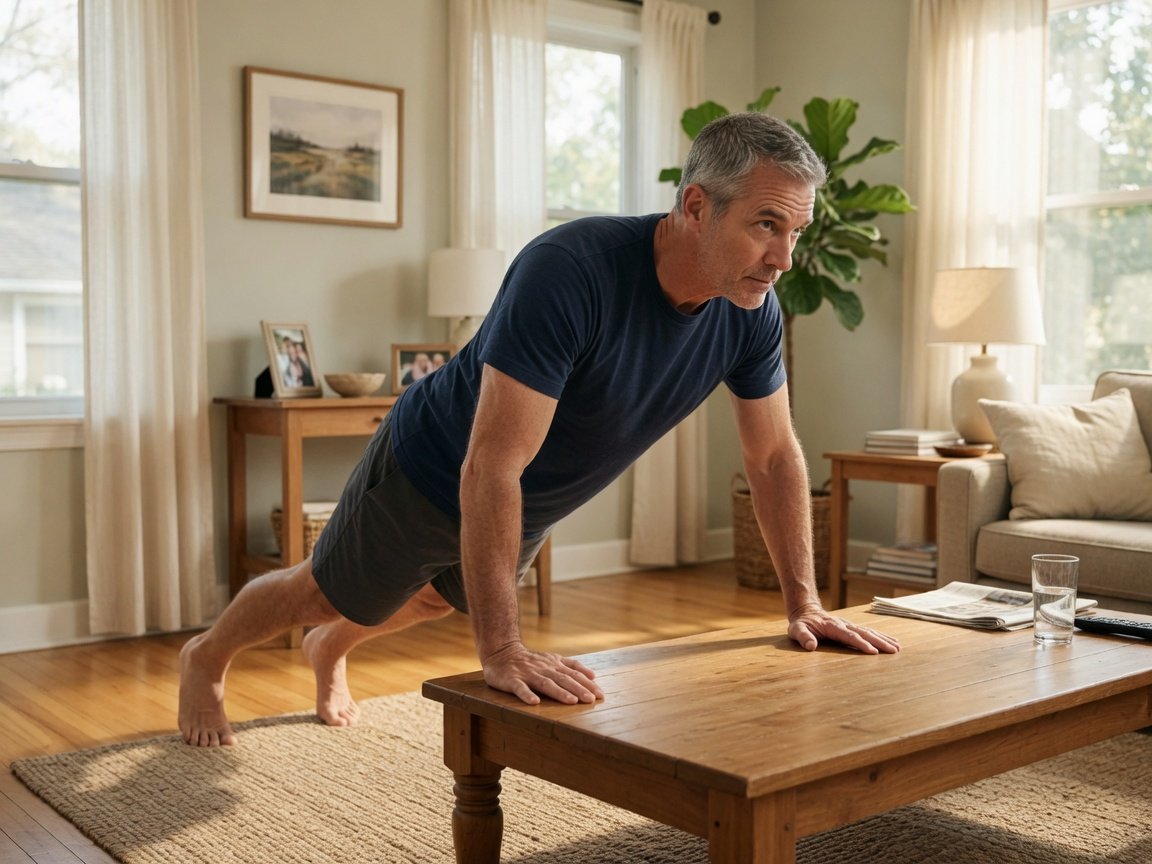
Home workouts over 50 work when they are short, repeated, and built around a chair and a wall. You do not need a garage gym. Three sessions — A, B, and an optional shorter C — cover the week. This is the home version of the fitness over 50 guide.
What setup do I need?
A sturdy chair that will not slide. A wall or kitchen counter. Optional: two grocery bags, a backpack, or a pair of dumbbells from 5 to 20 pounds. A timer. Shoes with a little grip.
Clear a walkway for carries. That hallway is your farmer-carry track.
What is Home Session A?
Warm up 4 minutes: march, shoulder rolls, sit-to-stand × 8, hinge × 8.
| Move | Sets × reps | Rest | No-equipment version |
|---|---|---|---|
| Squat to chair | 3 × 8–12 | 90 sec | Pause 2 sec just above the seat |
| Backpack or band row | 3 × 8–12 | 90 sec | Towel row around a post |
| Counter push-up | 3 × 8–12 | 90 sec | Wall push-up |
| Suitcase carry | 3 × 30 sec/side | 60 sec | Walk with a full laundry basket |
| Standing pallof or hands-pressed dead bug at wall | 2 × 8/side | 45 sec | Seated march |
What is Home Session B?
| Move | Sets × reps | Rest | Chair swap |
|---|---|---|---|
| Sit-to-stand, slow down | 3 × 8 | 90 sec | Higher chair |
| Hip hinge with bag | 3 × 8–10 | 90 sec | No bag, hands on hips |
| Band pulldown from doorway | 3 × 8–12 | 90 sec | Two-hand row |
| Supported split squat | 2 × 6–8/side | 90 sec | Sit-to-stand |
| Calf raise + tandem stance | 3 × 10 and 20 sec | 45 sec | Hold the counter |
What is optional Session C?
On a third day if you feel good: 20 minutes. Glute bridge 3 × 10, wall push-up 2 × 10, row 2 × 10, farmer carry 2 × 40 sec, then 8 minutes of balance exercises after 50. If the floor is a problem, swap bridges for extra sit-to-stands.
How do I schedule home workouts over 50?
- Do A on Monday. Do B on Thursday. Walk on Tuesday, Friday, and Saturday.
- Add C only after two easy weeks of A and B.
- If knees complain, raise the chair and drop split squats.
- If the back complains, shorten hinges and keep bags close.
- If shoulders complain, keep push-ups on the wall.
- If energy is low, do two sets of A and go walk outside. Pair this with the workouts after 50 week and strength training after 50 for loading rules. Joint limits? Use exercises for joint pain after 50.
How do I make a small home actually work?
You need six feet of floor and a hallway. Push a chair back. That is the gym. Do not wait for a spare room.
If downstairs neighbors hear every squat, slow the sit and skip jumping forever. Slow sit-to-stands are quieter and better for knees.
A 15-minute version exists for chaotic days: sit-to-stand 2 × 8, row 2 × 8, wall push-up 2 × 8, carry 2 × 20 seconds. Then walk the block. I use that version when the grandkids are over and the house is loud. It still counts as a home workout over 50.
Keep a printed copy on the fridge. Phones get you lost. Paper does not.
How will I know the home plan is working?
Week two: sit-to-stands feel less like a project. Week four: the backpack row can take another book. Week six: you carry both grocery bags without setting one down on the porch.
If nothing feels easier after four honest weeks, you are either skipping rest between sets, using a range that is too small to count, or missing sessions. Two completed A and B days beat five partial attempts.
Travel days: wall push-ups in a hotel, sit-to-stands on the bed-height chair, and a 15-minute walk. Do not wait to get home to be a person who trains. Home workouts over 50 are a mindset as much as a room.
What should you read next?
Keep using this plan for four weeks before you add extras. Then branch out.
Frequently asked questions
Can home workouts over 50 replace the gym?
Yes, for most people. A chair, a wall, and a loaded bag cover squat, hinge, push, pull, and carry.
How many days a week should I train at home?
Two strength days and walking on most other days.
What if I have no weights?
Use a backpack with books, grocery bags, or slower sit-to-stands with a pause.
Are floor exercises required?
No. Chair and standing swaps exist for every move on this page.
How long is each home session?
Twenty-five to thirty-five minutes including the warm-up.